Continuous Transformer Condition Data & ISO 55001:2024
Which clauses of ISO 55001:2024 continuous condition data can supply, what remains the customer's own to satisfy, and the value case in capital terms.

Predictive action now has a clause number.
Executive Summary
ISO 55001:2024 is not a cosmetic revision of the 2014 edition. It adds a required framework for asset management decision-making, rewrites the data and information requirements, and renames preventive action to predictive action with a full technical revision of that subclause. Organizations certified to the 2014 edition must complete a 2024 certification audit before 31 July 2027.
For a transformer fleet, the three changed areas all resolve to the same question: can you state, with evidence, what a specific unit will do next and why you believe it. This paper maps the clauses of ISO 55001:2024 that continuous condition data can supply, states plainly what remains the customer's own to satisfy, and shows the value case in capital terms.
An asset management system is a decision framework. ISO 55001:2024 makes that explicit in a way the 2014 edition did not, by adding Clause 4.5, which requires a documented framework for asset management decision-making, defined decision criteria, and appropriate methods, processes and tools to support those decisions.
Three of the 2024 changes bear directly on transformer fleets:
Clause 10.3 replaces preventive action with predictive action. It requires processes that predict the future behavior of a parameter needed to support a decision, so the organization can anticipate what is coming and determine optimal intervention points. Age is not a predicted parameter. It is a proxy.
Clause 7.6 replaces the former information requirements clause with data and information. It requires documented specifications covering data attributes, quality, and sources, and traceability between financial and non-financial data.
Clause 8.1 now states explicitly that operational planning and control includes life cycle management across creation, acquisition, utilization, maintenance, improvement, renewal, and disposal.
Continuous condition data does not make an organization conformant. It supplies the measured parameter that Clause 10.3 asks the organization to predict, the traceable criteria Clause 4.5.2 asks it to define, and the specified data Clause 7.6 asks it to document. The governance around those inputs remains the organization's own work.
This paper is written for asset management managers, reliability engineers, and internal auditors preparing a 2024 transition. Section 12 contains the full clause map. Appendix A is an evidence checklist you can take into a gap analysis.
Why the 2024 edition changes the argument
The 2014 edition was permissive about data. It required an organization to determine the information it needed and to keep it. It did not require the organization to say what good data looks like, how a decision gets made, or how a future condition gets predicted. Ten years of implementation exposed the gap. Decision frameworks were informal. Condition data was thin and disconnected from the plans it was supposed to inform.
The second edition closes that gap with specific requirements. The following changes matter most to an organization managing power or distribution transformers.
The transition deadline is a date, not a theme. Certified organizations must complete a 2024 audit before 31 July 2027. Every gap analysis being written now is being written against these clause numbers.
Clause 10.3: predictive action
Clause 10.3 replaces the 2014 subclause on preventive action. Read on its own terms, it requires the organization to establish processes for predictive actions, meaning actions that predict the future behavior of a parameter required to support decision-making, so that it can better anticipate future occurrences and impacts of nonconformities and opportunities, and determine optimal intervention points.
Three phrases in that requirement do real work.
A parameter
Not a category, not a score, not a bucket. A parameter is a measurable quantity with a unit and a value. Vibration amplitude at a defined frequency is a parameter. Winding hot spot temperature is a parameter. Asset class is not. Manufacture year is not.
Future behavior
Prediction requires a trajectory, which requires history at sufficient resolution to establish a rate of change. An inspection every one to five years produces a sequence of unrelated snapshots. It can confirm a condition already present. It cannot produce a rate.
Optimal intervention points
Optimality implies a defensible objective function. Intervening earlier than necessary consumes capital that had remaining life available. Intervening later risks the failure. Locating the point between them requires knowing how much life remains and how fast it is being consumed.
A calendar-based program cannot satisfy Clause 10.3, because the interval is set before any parameter is measured. The interval is an assumption about the population. Clause 10.3 asks about the asset.
What Clause 10.3 asks a transformer fleet operator to produce is therefore specific: a parameter measured on each unit, a history dense enough to establish its trajectory, a stated relationship between that parameter and a physical degradation mechanism, and an intervention threshold derived from that relationship rather than from convention.
Clause 4.5: decision criteria and the line of sight
Clause 4.5 is the largest structural addition in the 2024 edition. It strengthens the alignment of asset management from the strategic level to the operational level, the concept the discipline calls line of sight, and it requires consistent decision-making aimed at realizing value from assets. It has three parts: a framework for decision-making (4.5.1), the criteria to be used (4.5.2), and appropriate methods, processes and tools (4.5.3).
Line of sight runs downward. Organizational objectives inform the SAMP. The SAMP informs asset management objectives. Those objectives inform asset management plans. The plans inform activity on individual assets. Each link is supposed to be traceable to the one above it.
For most transformer fleets the line of sight is intact at the top and broken at the bottom. The SAMP states a reliability objective. The replacement plan states a number of units per year. The selection of which units is made on age, nameplate, and the recollection of whoever last visited the substation. There is no measured input at the point where the plan meets the asset, so the traceability that Clause 4.5 requires terminates one level above the decision it is meant to govern.
What 4.5.2 does to a risk rating
Clause 4.5.2 requires the organization to define the criteria used in asset management decisions. In an audit, that turns a severity rating into a claim that has to be substantiated. The auditor's question is short: this unit is rated high risk. On what basis?
A rating derived from a population baseline cannot answer it well. The honest answer is that the unit's signature differs from the signatures of other units in a reference set, by a margin someone chose. That answer invites three follow-up questions the organization usually cannot close: which units are in the reference set, why is that set representative of this unit, and what threshold was applied and who set it.
A rating derived from a physics-based model of the specific unit answers differently. The signal was measured. The signal maps to a mechanism. The mechanism drives a known failure mode. The severity follows from how far the mechanism has progressed. Each link is stateable, and each link is checkable by someone who was not in the room when the rating was produced.
Defensibility is a physics problem
The distinction in the previous section is not a matter of presentation. It follows from how the model is built. A worked example makes it concrete.
Worked example: loss of winding clamping pressure
Load current through a transformer winding produces Lorentz forces on the conductors. Force scales with the square of current, and squaring a sinusoid at power frequency produces a constant term plus a component at twice that frequency. On a 60 Hz system the winding is therefore driven mechanically at 120 Hz. The core contributes at the same frequency and its harmonics through magnetostriction, the dimensional change of the core steel under a varying magnetic field.
Clamping pressure holds the winding block in compression. As pressure relaxes through thermal cycling, short circuit events, and insulation shrinkage, the mechanical stiffness of the block falls. Falling stiffness lowers the natural frequencies of the structure. As those frequencies move toward the driving harmonics, the amplitude at those harmonics rises and the distribution of energy across the harmonic series changes shape. Triaxial accelerometers on the tank wall observe that change.
Amplitude alone is not diagnostic, because it also rises with load and falls with oil temperature as viscosity changes. This is where the model matters. VIE normalizes the observed response against the unit's own measured load, thermal state, and ambient conditions, using a virtual model built from that transformer's construction rather than a baseline learned from a population of other units. Magnetic field measurement separates core excitation from load-driven winding response. Local weather data closes the ambient term.
The reason this matters under Clause 4.5.2 is that a clean reading becomes affirmative evidence, not merely an absence of an alarm. If the model predicts the response of a healthy unit at a given load and temperature, and the measurement matches the prediction, the organization has positive evidence of health it can put in front of an auditor. A population-baseline system that produces no alarm has only established that nothing looked unusual.
Clauses 7.6 and 7.7: data, information, and knowledge
7.6 Data and information
The 2024 edition rewrote this clause. It now distinguishes data from information in an asset management context and requires documented specifications covering data attributes, quality, and sources, with alignment and traceability between financial and non-financial data.
The practical consequence is that a monitoring deployment has to arrive with documentation, not just an interface. For each measured quantity the organization needs the unit, the sampling interval, the measurement uncertainty, the sensor location and its provenance, the retention period, and the identifier that links the reading to a specific transformer in the asset register. VIE supplies that specification as a document per deployment, which becomes part of the customer's Clause 7.6 evidence rather than something they have to reconstruct.
The financial traceability requirement is the harder half, and it is the customer's. A condition record supports a replacement decision, that decision produces a capital entry, and the clause asks that the two be traceable to each other. That link is made in the customer's asset register and financial system, using the asset identifier VIE carries on every reading.
7.7 Knowledge
This subclause is new. It requires the organization to determine the knowledge needed to operate the asset management system, retain it, keep it current, and handle knowledge that has gone out of date.
For most transformer fleets the binding knowledge risk is people. The judgment that connects an observation to a likely mechanism often sits with a small number of long-tenured engineers and leaves when they do. A physics-based model is one way to hold part of that knowledge in a form the organization retains. The model encodes the relationship between measured signal and physical mechanism explicitly, which means it can be documented, reviewed, and taught. That is a legitimate 7.7 argument, and it is worth making carefully rather than overstating: a model holds the mechanism, not the operational judgment about what to do next.
Clauses 8.1 and 8.3: life cycle and external provision
8.1 Operational planning and control including life cycle management
The revised clause states explicitly that operational planning and control covers life cycle processes: creation, acquisition, utilization, maintenance, improvement, renewal, and disposal. It also states that treating the risks and implementing the opportunities identified under Clause 6.1 is an integral part of operational planning and control.
Condition data has a role at four of those gates. Utilization: how hard a specific unit can be loaded, given its measured mechanical and thermal condition rather than its nameplate. Maintenance: whether an inspection is warranted now. Improvement: whether a repair restores enough margin to justify the outage. Renewal: where the unit sits in the replacement sequence. The gates are the same ones the fleet already manages. The clause asks that the decision at each one be planned and controlled rather than inherited from a schedule.
8.3 Externally provided processes, products, technologies and services
The 2014 clause on outsourcing became, in 2024, externally provided processes, products, technologies and services. The requirements did not change substantially, but the wording puts a monitoring vendor unambiguously inside the scope of things the organization must control and evidence.
That works in a customer's favor if the vendor supplies what the clause needs. For a VIE deployment, the artifacts a customer needs under 8.3 are the scope of the externally provided service, the performance requirements against which VIE is evaluated, the data specification referenced in Clause 7.6, and the interface control document for the REST API. VIE supplies these at deployment. Requesting them from any monitoring vendor is a reasonable procurement test, and a vendor that cannot produce them is creating a Clause 8.3 gap for the customer to close later.
Clause 4: climate change is now in scope
The Harmonized Structure amendment applied across ISO management system standards requires an organization to determine whether climate change is a relevant issue in its context, and to consider relevant stakeholder requirements related to it. ISO 55001:2024 carries that requirement in Clause 4.
For a transformer fleet the determination is not difficult to make. Insulation aging follows an Arrhenius relationship, so the rate of life consumption is exponential in winding temperature, and winding temperature tracks ambient. IEEE C57.91 already provides the model. What has changed is the input distribution: higher summer ambient temperatures and longer sustained heat events shift a fleet's thermal duty upward, and the same load profile consumes life faster than the loading study assumed.
There is a second-order effect worth stating because it compounds the first. Long lead times for new transformers push operators to load existing units harder rather than add capacity. Harder loading raises winding temperature. Higher temperature accelerates Arrhenius aging. Accelerated aging brings end of life forward across the fleet at the same time, which increases replacement demand and extends lead times further. The loop tightens itself.
Under Clause 4 this is now a documented context issue rather than an operational complaint. An organization that has determined climate change is relevant needs some measure of the effect. Measured thermal duty per unit, trended, is that measure.
Where ISO 55001 sits relative to the transformer standards
ISO 55001 is a management system standard. It governs how decisions get made and evidenced. It does not tell an engineer what to measure on a transformer, what to call a failure, or how to convert temperature into consumed life. Three other standards do that work, and a condition data source has to serve all four layers to be usable inside an audited asset management system.
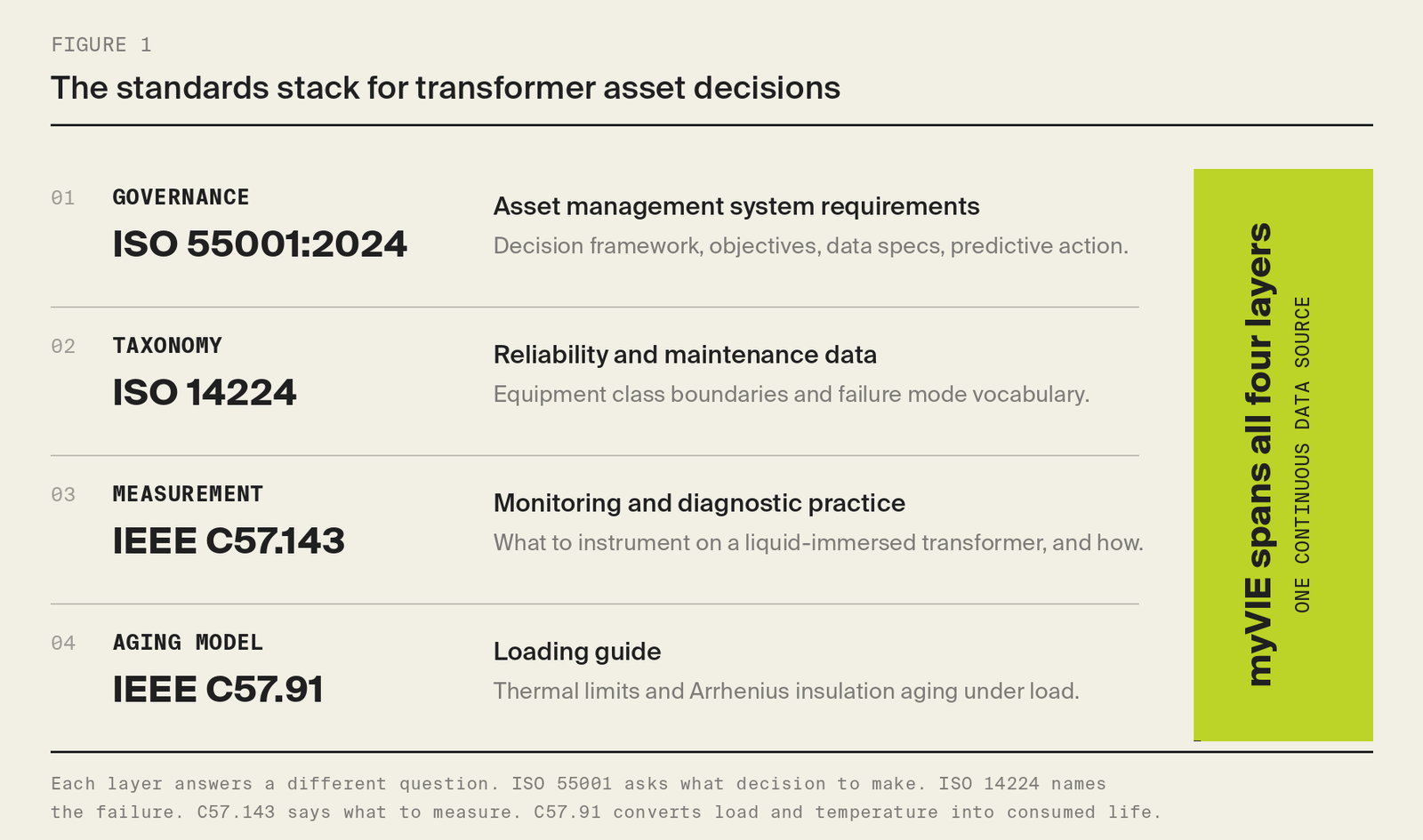
The layers are not interchangeable. An organization can hold ISO 55001 certification with a transformer program that measures nothing, because the standard does not prescribe instrumentation. Equally, a monitoring deployment that produces excellent measurements but cannot express its output in ISO 14224 failure mode vocabulary, or connect it to a C57.91 aging calculation, gives the asset management system a dashboard rather than evidence.
The value case in capital terms
ISO 55001 states its own purpose as realizing value from assets. A conformance argument that never reaches a number is incomplete. The mechanism through which continuous condition data produces value in a transformer fleet is resequencing: capital moves later on units with remaining life, and earlier on units without it.
The following worked example uses stated assumptions. Substitute fleet-specific values.
Two features of this example matter more than the total. First, it moves capital in both directions. A model that only ever recommends deferral is a cost avoidance tool that an auditor and a regulator will both discount. Second, the largest line is excluded. Avoided failure cost is real and usually dominates, but it is estimated rather than measured, so it does not belong in the number a capital committee is asked to approve.
For a rate-regulated utility there is a further consideration. A replacement program justified by measured condition is easier to defend on prudence grounds than one justified by age, because the record shows the specific evidence behind each unit's inclusion. The Clause 4.5.2 documentation the standard now requires is the same documentation a prudence review asks for.
Clause map
The table below maps ISO 55001:2024 clauses to the evidence continuous condition data can supply. Clause numbering follows the second edition.
Scope and boundaries
Two limits should be stated plainly, because a conformance argument that overstates its reach fails at the first audit.
VIE is a condition data source, not an asset management system. It does not satisfy the leadership, organizational, or governance requirements of Clauses 4, 5, and 10 on its own, and it does not author the SAMP, the asset management policy, or the asset management objectives. It supplies data those artifacts are built on.
VIE Technologies Inc. is not a certifying body. VIE does not audit or attest to a customer's ISO 55001 conformance. Any conformance statement is the customer's own to make, based on their complete asset management system.
A current integration limit
VIE does not integrate directly with SCADA, historian, or CMMS platforms. Data reaches the customer's asset management information system through the REST API. Under the 2014 edition this was a minor implementation detail. Under Clause 7.6, which asks for traceability between financial and non-financial data, it means the customer carries the integration work needed to close that link. VIE states this openly rather than leaving it to be discovered during a gap analysis.
Implementation path
Five steps, sequenced to follow a 2024 transition gap analysis.
- Establish the fleet condition baseline before writing the SAMP section on transformers. A Clause 6.2.1 artifact built on an age distribution will need rewriting once measured condition contradicts it, and it usually does.
- Write the Clause 4.5.2 decision criteria for transformer intervention explicitly, stating the parameter, the threshold, and the physical basis for the threshold. This is the document the internal auditor will ask for under 9.2.
- Take delivery of the data specification and register it as Clause 7.6 documented information. Confirm it covers units, sampling interval, uncertainty, sensor provenance, retention, and the asset identifier.
- Connect the REST API to the asset management information system, and establish the identifier link between condition records and the capital entries they support, to close the financial traceability requirement in 7.6.
- Define the Clause 10.3 predictive action process in writing: which parameter is predicted, over what horizon, with what confidence, and how the intervention point is derived. Then route severity and trajectory alerts into the Clause 8.1 planning cycle and the Clause 9.3 management review.
Conclusion
The 2014 edition of ISO 55001 could be satisfied by an organization that documented its intentions carefully. The 2024 edition asks for more. It asks what the decision framework is, what the criteria are, what the data specification says, and how a future condition is predicted. Those questions have measured answers or they have assumed ones.
For transformer fleets, continuous physics-based condition data supplies the measured answers to the clauses that ask for them, most directly 4.5, 7.6, and 10.3. It does not supply the governance the standard requires, and it does not certify anything. Positioned accurately, it is the layer that lets an asset management system's transformer decisions be defended by evidence rather than by convention.
Appendix A: Auditor evidence checklist
Take this into a Clause 9.2 internal audit or a 2024 transition gap analysis. The final column is the customer's own work in every row.